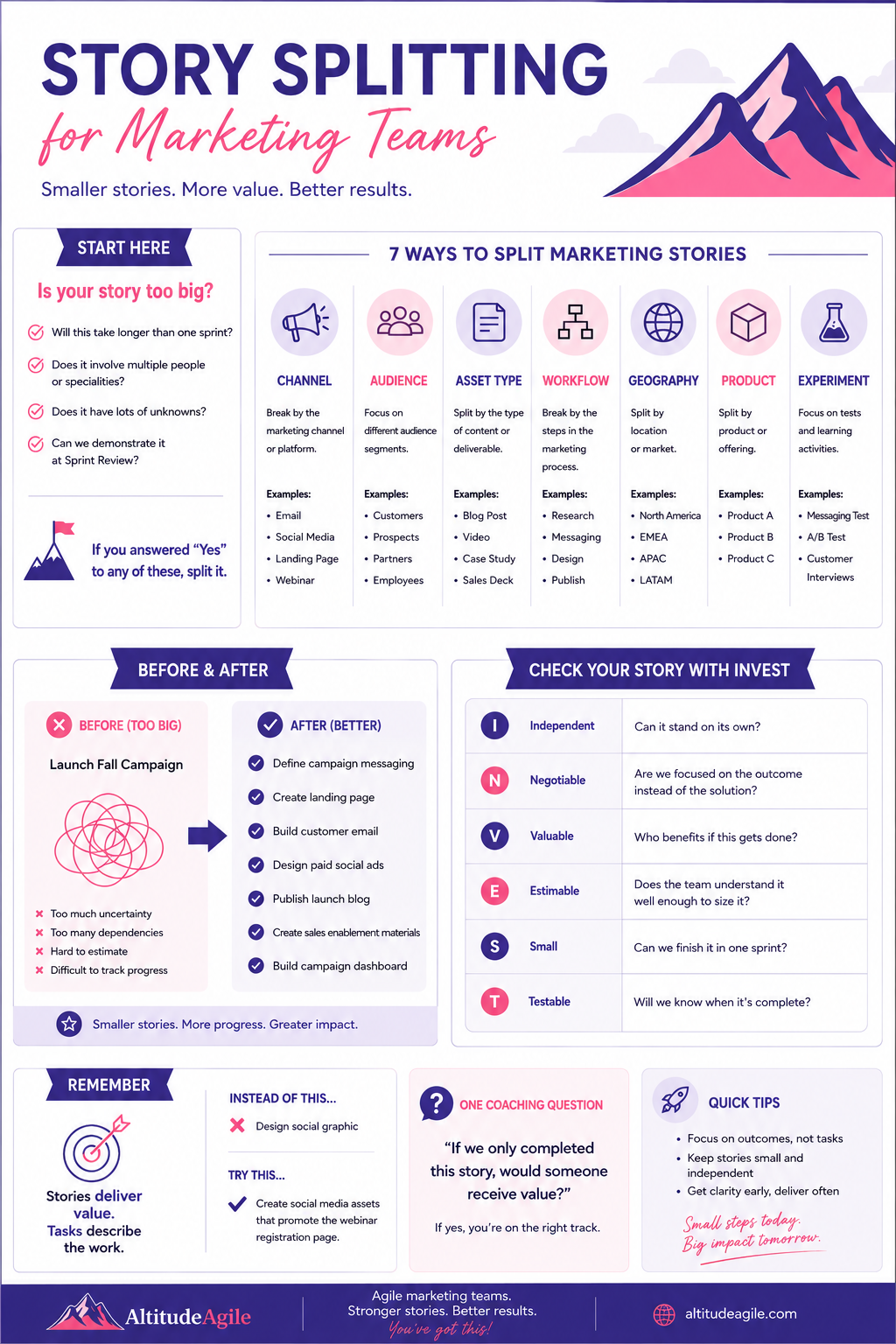

Story Splitting for Marketing Teams: A Practical Guide
One of the biggest challenges marketing teams face when adopting Agile is figuring out how to make work small enough to complete within a sprint. Campaigns, product launches, website redesigns, and events often feel too large to fit into a single iteration. In the same vein, there is also the question of if work is being broken down too small for effective planning, especially at a leadership level.
The good news is that almost every marketing initiative can be broken down into pieces that deliver value sooner, reduce risk, and create better visibility for stakeholders, regardless of what altitude you are looking at the sprint work at.
What Is Story Splitting?
Story splitting is the practice of taking a large piece of work and dividing it into smaller, independent work items that can be completed within a sprint.
A good marketing story should:
- Deliver something valuable.
- Be small enough to finish in one sprint.
- Be testable or reviewable.
- Move the overall initiative forward.
The goal isn’t to create more work—it’s to make progress visible and predictable.
Why Marketing Teams Benefit from Story Splitting
Large marketing projects often hide uncertainty. Splitting work helps teams:
- Get feedback earlier.
- Reduce bottlenecks.
- Improve forecasting.
- Adapt to changing priorities.
- Celebrate progress more frequently.
Instead of waiting six weeks to launch a campaign, teams can complete valuable pieces every sprint.
Common Story Splitting Techniques
Split by Channel
Instead of:
Launch Fall Campaign
Try:
- Create email campaign
- Create paid social campaign
- Create organic social assets
- Create landing page
- Develop sales enablement materials
Each delivers value independently while contributing to the larger campaign.
Split by Audience
Instead of:
Develop customer messaging
Create separate stories for:
- Existing customers
- Prospects
- Partners
- Internal employees
Each audience often requires different messaging, approvals, and creative assets.
Split by Asset Type
Large content initiatives are perfect candidates.
Instead of:
Create product launch content
Split into:
- Blog article
- Customer email
- Sales one-pager
- FAQ document
- Social graphics
- Video script
Each asset can move independently through review and approval.
Split by Workflow Stage
Marketing work often follows a predictable process.
Rather than one massive story, create stories such as:
- Research customer insights
- Draft messaging
- Design creative
- Stakeholder review
- Final production
- Publish assets
This approach works especially well when different specialists own different stages.
Split by Geography
For global organizations:
Instead of:
Launch campaign worldwide
Split into:
- North America launch
- EMEA localization
- APAC localization
- LATAM adaptation
Each region may have unique translations, regulations, and approvals.
Split by Product or Service
Instead of:
Update website for new offerings
Create separate stories for:
- Product A pages
- Product B pages
- Pricing updates
- Resource library
- Customer stories
This allows teams to release improvements incrementally.
Split by Risk
If part of the work is uncertain, isolate it.
Examples:
- Conduct customer interviews
- Test messaging concepts
- Validate landing page copy
- Run A/B test
Learning is valuable work. It deserves its own story.
What Doesn’t Make a Good Story Split?
Not every task should become a separate story.
Avoid splitting work into technical or functional tasks like:
- Write copy
- Design graphics
- Build email
- QA landing page
These are usually tasks within a single story, not independent pieces of customer value.
A good question to ask is:
“If we completed only this story, would someone benefit from it?”
If the answer is yes, it’s probably a good story.
Example
Too Big
Create Q4 Product Launch Campaign
Better
- Define launch messaging
- Create launch landing page
- Develop customer email campaign
- Create paid social ads
- Publish launch blog
- Create sales presentation
- Produce launch video
- Build campaign dashboard
Each story is independently valuable and can be completed during a sprint.
Story Splitting Checklist
Before bringing a story into Sprint Planning, ask:
- Can this be completed within one sprint?
- Does it deliver something meaningful?
- Can it be reviewed or demonstrated?
- Does it depend on completing many other stories first?
- Could we release or use this independently?
If the answer to several of these questions is “no,” the story probably needs to be split further.
Final Thoughts
Story splitting isn’t about making work smaller for the sake of estimation. It’s about creating a steady flow of value.
For marketing teams, that means fewer stalled projects, more frequent stakeholder feedback, and greater confidence in delivery. As teams become more comfortable splitting work into meaningful increments, planning becomes easier, forecasting improves, and Agile starts to feel much more natural.
For quick reference, check out and share this guide.